You Thought ZIMRA Couldn’t See You. That Was Never Really True.
The first time a foreign client paid you, you probably didn’t think about tax. The money landed in a Payoneer wallet, came from a client on Upwork or Fiverr, and felt completely separate from Zimbabwe’s financial system. ZIMRA taxes what it can see. It couldn’t see this. That was the logic, and for a long time it was a reasonable read of reality.
It’s a less reasonable read now.
This isn’t about the content creators making $20,000 a month. That story got covered. This is about the person making $500 from a brand deal, $800 freelancing for a UK agency, $300 from YouTube. The person who never thought of themselves as a tax problem because they never thought of themselves as a business.
That’s exactly who this applies to.
The invisible money myth
Zimbabwe’s digital freelance economy runs on a quiet assumption: if the client is foreign, the platform is foreign, and the money never touches a Zimbabwean bank account, then Zimbabwe has no claim on it.
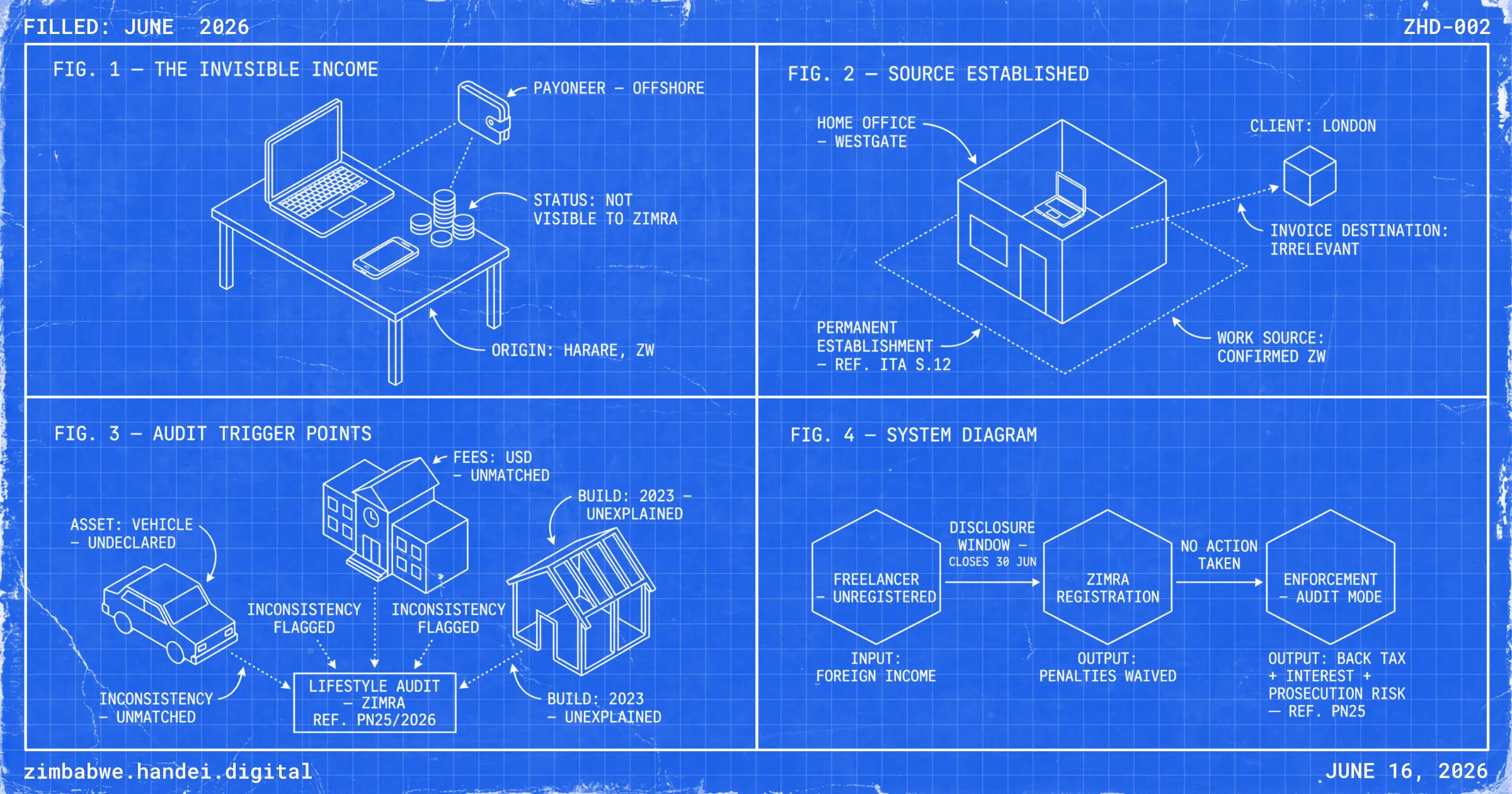
The assumption has two problems. The first is legal. Zimbabwe uses a source based tax system, meaning income is taxed where the work originates. You are in Harare. The work originates in Harare. Where the client sits, where the invoice goes, where the money lands first none of that moves the source. A Zimbabwean freelancer billing a London company from a desk in Westgate is earning Zimbabwean sourced income. The offshore account is a payment method, not a tax structure.
The second problem is practical. The tools ZIMRA couldn’t use three years ago exist now. Mobile money trails. Bank record requests. Lifestyle audits that don’t require proving your income, only asking you to explain why your spending doesn’t match your declarations. If you bought a car, paid school fees in USD, or built anything in the last two years, that’s the kind of inconsistency that opens a conversation you don’t want to have without a tax professional in the room.
The offshore registration trap
A lot of Zimbabwean freelancers and small agency owners went one step further. They registered a company in the UK, South Africa, or Dubai. The thinking was cleaner that way: foreign company, foreign tax problem, nothing to do with ZIMRA.
The law has a term for what you built: permanent establishment. Under Zimbabwe’s Income Tax Act, a company is resident in Zimbabwe if its management and control are exercised in Zimbabwe. Not where it’s incorporated. Where it’s run from. To make this explicit, if you’re providing services from Zimbabwe for more than 90 days in any twelve month period, that counts as a permanent establishment. Your home office in Harare is a permanent establishment. Your laptop is a permanent establishment. The UK registration doesn’t move the liability. In some cases it creates two liabilities, one in each country, unless you’re using the double taxation treaty between Zimbabwe and wherever you registered. Most people who registered offshore to solve a tax problem don’t know the double taxation treaty exists.
What actually changed
Nothing in the law changed. What changed is that ZIMRA is paying attention to a sector it previously ignored. The April 2026 voluntary disclosure notice, Public Notice 25 of 2026, named it directly: people who “earn income from online platforms or digital services” and people who “earn income from foreign companies while residing in Zimbabwe.” That’s not a new tax category. It’s an existing one that’s being enforced for the first time at this scale.
The same Finance Act also introduced a Digital Services Withholding Tax. This is not a new tax but a better way to capture the tax on digital services. Based on the VAT act, when a service is supplied in Zimbabwe, VAT is supposed to be charged by the supplier if they meet the VAT thresholds. For digital services it was really difficult to collect this tax as non-declaration would mean there would be no way to confirm the tax amount. The digital service withholding tax fixes this by withholding the tax amount at source of paying i.e the bank withholds the amount. The supplier will be able to treat the amount withheld as tax already paid when the do their actual return. If you’re spending USD on foreign software for your business, that tax is already touching you whether you know it or not.
The voluntary disclosure window from Public Notice 25 of 2026 closes June 30. Coming forward before then waives penalties in full. After that, the standard enforcement framework applies, meaning audits, back taxes, compounding interest, and possible prosecution. That window is worth knowing about even if the notice itself felt like it wasn’t aimed at you.
The honest question
If you’re making $500 a month from freelance work or creator income and you’re not registered with ZIMRA, the question isn’t whether you owe tax. You probably do. The question is whether the cost of regularising now is lower than the cost of being found later. For most people at this income level, it is. The tax on $500 a month is not a business ending number. An audit covering three unregistered years, with penalties and interest, is a different conversation.
A qualified Zimbabwean tax professional can tell you what your specific situation actually costs to fix. That number is almost always smaller than people expect before they ask.