Econet vs Starlink, What Real Competition Could Mean for Your Data Bill
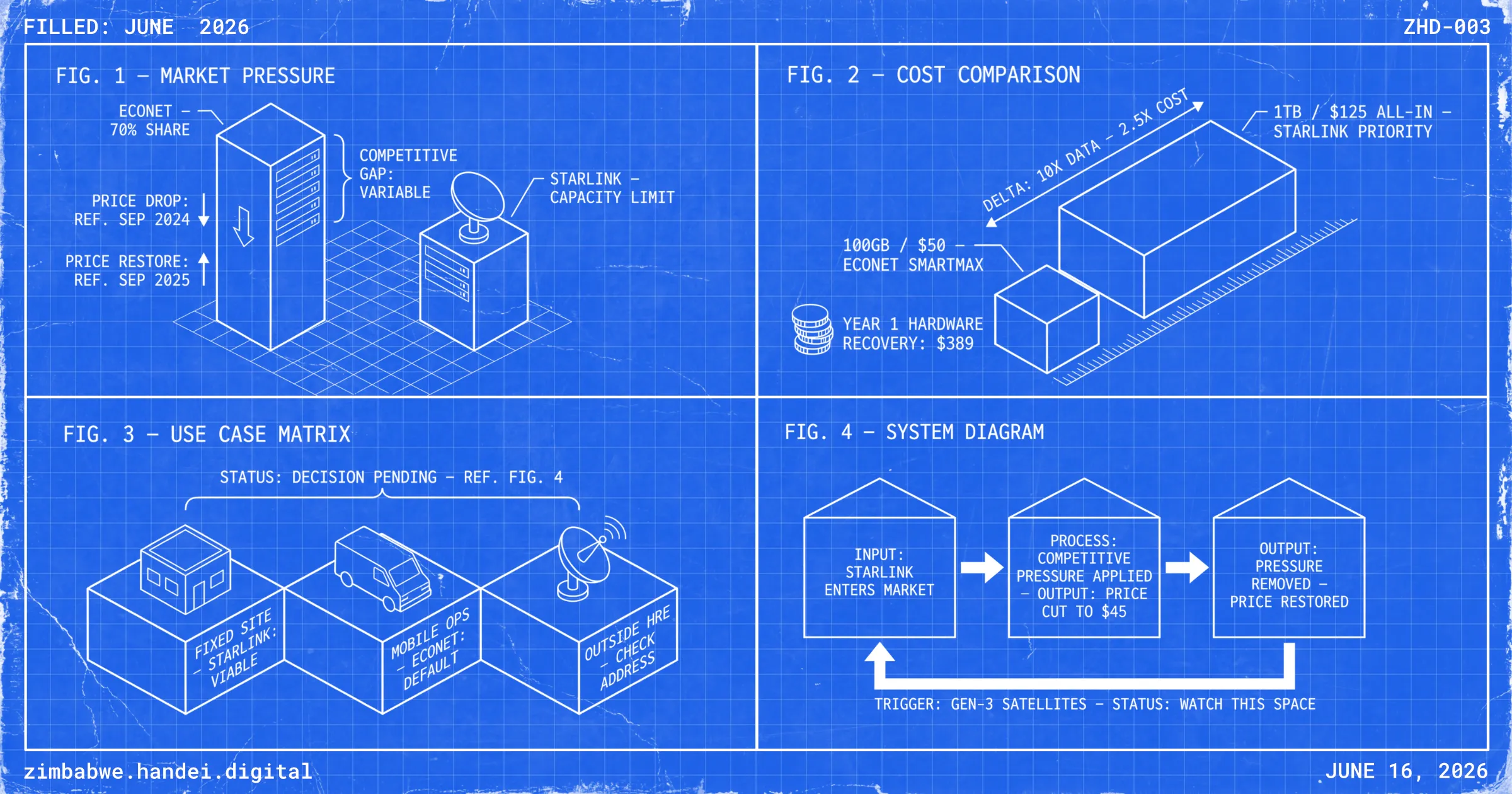
Starlink landed in Zimbabwe in September 2024. Within weeks, Econet cut its data prices to levels nobody had seen before. Fifteen months later, Starlink is still struggling to keep Harare connected. Econet’s prices are back up. Make of that what you will.
Here’s the timeline. When Starlink launched, Econet rolled out SmartBiz: unlimited data, 100 Mbps speeds, $45 a month, no geo locking. Around 100,000 people signed up. Then Harare and Bulawayo hit Starlink’s capacity limit and stayed that way for 15 months. In September 2025, Econet replaced SmartBiz with SmartSuite. The new entry-level: 50GB for $30. The flagship: 800GB for $170. Unlimited disappeared entirely. Econet looked at a market where the main competition was stuck on a waitlist and priced accordingly. Funny how that works.
The numbers are worth sitting with.
Econet SmartSuite SmartMax is 100GB for $50 a month. Starlink Priority, now available directly in Harare since February 2026, is 1TB for $100, or about $125 once you account for Zimbabwe’s 15% Digital Services Withholding Tax and bank fees. That’s 10 times more data for 2.5 times the price. The Standard Kit hardware is a one-time $389.
At Econet’s SmartMax rate, 1TB of data costs $500 a month. You recover Starlink’s hardware cost in the first month alone. Elon Musk has never done anything for Zimbabwe specifically, but the math doesn’t care.
Run that forward for a year. A business on SmartBiz at $45 a month was spending $540 a year. The same business on SmartSuite SmartMax at $50 a month, actually using more than 100GB, is spending $600 a year minimum and likely topping up. Starlink Priority at $125 a month all-in is $1,500 a year, plus a $389 one-time hardware cost. After the first year, Starlink is cheaper. By year two, it’s not close.
Let’s be honest about what’s happening here.
Econet has 11 million subscribers, 70% market share, and the widest 4G coverage in the country. That coverage advantage is real, & it matters. But the SmartBiz story tells you exactly how Econet thinks about pricing: the $45 unlimited plan existed because Econet needed it to. The moment the pressure came off, so did the deal. Econet’s data prices aren’t a function of what connectivity costs to deliver. They move with competitive pressure, and right now there isn’t much. Twenty-five years of market dominance will do that to a pricing strategy.
What you should do depends on how your business actually runs.
If you’re in a fixed location in Harare or Bulawayo, Starlink is worth running the numbers on now. Starlink started taking new customers in Harare again in February 2026. The $30 residential plan isn’t available in high-demand areas yet, so you’re looking at Priority at $100 a month, but if your current data bill is already above $80 a month the case is straightforward.
If you need to stay mobile, field sales, deliveries, multiple sites, Econet is still the default answer. The Starlink Mini does work from a moving vehicle, but only on the Roam plan at $165 a month unlimited. At that price, Econet starts looking reasonable again.
If you’re outside Harare or Bulawayo, you may have access to the $30 residential Starlink plan already. Worth checking your address at starlink.com before your next Econet top-up.
The thing to watch: SpaceX is rolling out third-generation satellites through 2026, which should push more capacity into Zimbabwe. The last time Harare got real Starlink access, Econet dropped to $45 a month. That’s the number to keep in mind.
The bottom line is Econet gave you a good deal once & Starlink was why.